
By Lee Werrell, Chartered FCSI, Founder, Compliance Consultant
Moving from appointed representative to directly authorised firm is one of the most consequential steps a regulated business takes. A scaling UK investment-based crowdfunding platform worked with Compliance Consultant to secure its own Part 4A permissions. For this type of platform, the FCA’s focus falls on the high-risk investment promotion rules introduced by PS22/10 and on financial projections that hold up under severe but plausible stress. By aligning the regulatory business plan with a customised, operating compliance monitoring plan and stress-tested financial projections, we helped the platform submit one consistent, evidenced application. This case study sets out the document structures, financial models and governance frameworks we prepared.
Key facts
Client: UK investment-based crowdfunding platform (anonymised at the client’s request)
Starting point: appointed representative of a principal firm
Objective: its own Part 4A permissions to launch proprietary investment structures and control investor onboarding
What we delivered: regulatory business plan, three-year stress-tested financial projections, tailored policy suite, live compliance monitoring plan
Outcome: direct authorisation granted
The situation: transitioning from appointed representative to fully authorised principal
Operating as an Appointed Representative (AR) offers a rapid entry route into the UK financial services sector, but it introduces significant commercial constraints. For a scaling investment-based crowdfunding platform, relying on a principal firm limited their ability to launch bespoke investment structures and directly control their investor onboarding pipeline. The platform needed its own Part 4A permissions for the regulated activities its model actually carries on: principally arranging deals in investments and making arrangements with a view to transactions in investments, together with (Operating an electronic system in relation to lending is the loan-based, peer-to-peer permission and does not apply to an equity or debt-security platform.)
This transition took place during a period of close regulatory attention. Investment-based crowdfunding is supervised by the FCA’s Consumer Investments Directorate, and in its January 2024 portfolio letter setting out expectations for investment-based crowdfunding platforms, the FCA pointed to client categorisation, appropriateness testing and risk warnings as areas where firms must prevent consumer harm.
Link: https://www.fca.org.uk/publication/correspondence/expectations-investment-based-crowdfunding-platforms-portfolio-letter.pdf
To manage this complex transition, the platform engaged our specialist regulatory compliance firm. We structured our advisory partnership around our defined “engage, execute, embed” methodology.
We defined this methodology operationally across three distinct stages:
-
- Engage: We established the exact, bespoke regulatory requirements matching the platform’s specific operating model before any new technology or administrative infrastructure was built.
-
- Execute: We drove necessary process and organisational changes in parallel with the platform’s system development to ensure compliance was built directly into the software.
-
- Embed: We integrated the compliance framework into daily operations, testing and scaling the controls under live conditions to demonstrate operational readiness to the case officer.

The problem: navigating three-year stress tests and generic policy failures
The primary obstacle to securing direct authorisation was proving financial resources adequacy under the FCA’s threshold conditions. Many scaling fintech platforms fail during the application stage because they treat financial forecasts as commercial pitch decks. The FCA case officers do not look for hockey-stick growth curves; they look for operational resilience and the exact capital buffers needed to survive severe market downturns.
For an investment-based crowdfunding platform, the application fee alone is £2,820 for arranging equity deals, or £5,640 if P2P lending permissions are required, as documented in the comparative analysis of UK Part 4A permissions. Beyond these upfront fees, the platform had to prove it met the capital adequacy thresholds. Inconsistent forecasts or overly optimistic revenue assumptions are immediate triggers for case officers to pause the assessment clock or return the application as incomplete.
The platform’s internal compliance arrangements before our engagement relied on generic, off-the-shelf policy templates. These static templates lacked the operational detail required to manage the risks of high-risk investment promotions. Case officers easily identify boilerplate documentation.
Specifically, the platform lacked:
-
- A tailored methodology for assessing whether retail investors met the criteria for restricted mass market investments.
-
- A documented wind-down plan showing how client assets and investments would be managed if the platform faced insolvency.
-
- A working compliance calendar that proved the firm had the bandwidth and resources to manage its regulatory reporting obligations on an ongoing basis.
The approach: how Compliance Consultant built the submission roadmap
For each scenario, we calculated the platform’s capital and liquidity requirements under the applicable prudential regime, e.g. MIFIDPRU own funds and basic liquid assets requirements and showed that it would hold resources above those requirements throughout the stress period.
Building a cohesive regulatory business plan
We rebuilt the platform’s Regulatory Business Plan (RBP) from the ground up. This document is the foundation of any application. Rather than detailing commercial aspirations, we focused on explaining how the platform’s operational flow complied with specific FCA sourcebook rules.
We structured the RBP to detail the exact flow of funds, the digital onboarding path for different investor classifications, and the systems used to review and approve financial promotions. We ensured that the operational narrative in the RBP matched the underlying financial models. For details on how we structure these documents, you can review our guide on how to write an FCA regulatory business plan that actually gets approved.
Demonstrating adequate financial resources
We built a three-year financial projection model that subjected the platform’s balance sheet to severe but plausible stress events. Our stress-testing model focused on three main scenarios:
-
- A 60% reduction in platform transaction volume over a consecutive six-month period.
-
- A significant operational disruption causing a complete halt to platform activities for 15 business days.
-
- The immediate loss of their primary banking partner, requiring a transition to a secondary payment provider.
For each scenario, we calculated the platform’s capital requirements and demonstrated that the business would maintain liquid assets well above the regulatory minimums. This financial modelling followed the precise framework detailed in our step-by-step roadmap on how to get FCA authorisation.

Structuring the compliance monitoring framework
To satisfy the FCA’s requirement for an operational compliance infrastructure, we implemented a custom Compliance Monitoring Plan. This was not a theoretical list of rules, but an active operational calendar detailing who was responsible for testing specific controls, how frequently those tests occurred, and how the results were escalated to senior management.
We established a comprehensive matrix of core policies designed specifically for their investment-based crowdfunding model:
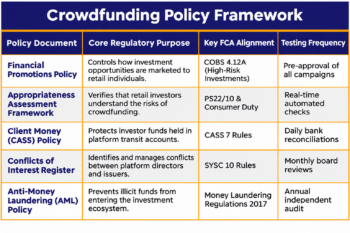
This framework was integrated into the platform’s day-to-day operations using the structured methodology from our project management playbook for FCA authorisation. This demonstrated to the case officer that the compliance team was already actively monitoring business activities before the formal decision was made.
The result: direct authorisation without stalled review clocks
By delivering a complete, highly synchronized application, the crowdfunding platform secured its direct Part 4A permissions to operate an investment-based crowdfunding platform.
The FCA has committed to deciding complete applications within four months and incomplete applications within ten months, down from the six and twelve months set by section 55V of FSMA, and has measured itself against the shorter deadlines since January 2026. The clock that matters is the one that starts when the application is complete.
The platform’s application was determined 5 months after submission, with no material information requests all answered within 3 days.
Because the application did not stall, the platform launched its proprietary investment structures on schedule and moved its existing investors from the appointed representative arrangement without operational downtime.

What this roadmap means for your FCA application
If your firm is planning to apply for direct FCA authorisation, you must treat your application as an active operational exercise rather than a legal hurdle. Case officers look for evidence that your compliance culture is functional and that your senior management understands their personal liabilities under the Senior Managers and Certification Regime (SMCR).
Three fundamental lessons emerge from this successful submission:
- Consistency is paramount: Your RBP, compliance policies, and financial models must tell the exact same story. If your business plan mentions manual KYC reviews for high-risk clients, but your financial forecast shows zero budget allocated to compliance staff or verification software, the case officer will reject the application as incomplete. For a detailed look at demonstrating this readiness, see our guide on how to prove your firm is ready, willing, and organised for FCA authorisation.
- Tailor your policies: Off-the-shelf manuals are a liability. Your compliance documentation must reflect your exact systems, your specific customer interface, and the precise regulatory permissions you are seeking.
- Operationalise before submission: You must show the regulator that you are already running your compliance monitoring plan. This means having draft registers, configured testing tools, and defined escalation paths ready to show the case officer on day one.
To help firms run this operational compliance structure once authorised, Compliance Consultant provides ongoing support through fixed-price retainers. Silver is £1,075 a month plus VAT billed annually (£12,900 plus VAT a year), or £1,195 a month plus VAT billed quarterly. Gold is £2,155 a month plus VAT billed annually (£25,860 plus VAT a year), or £2,395 a month plus VAT billed quarterly, and adds 10% off project work. Full details: https://complianceconsultant.org/compliance-retainer-services/
For a broader perspective on the entire regulatory path, you can explore the complete guide to FCA authorisation in the UK.
FAQs
Frequently asked questions
Can an appointed representative apply for its own FCA authorisation?
Yes. The firm applies for its own Part 4A permission while it continues to operate as an appointed representative. When the permission is granted, the principal ends the appointment and notifies the FCA, so the firm moves onto its own permissions without a gap in regulated cover.
How long does FCA authorisation take in 2026?
The FCA has committed to deciding complete applications within four months and incomplete applications within ten months, down from six and twelve months under section 55V of FSMA. The shorter clock only helps if the application is complete when it is submitted.
What is the FCA application fee for a crowdfunding platform?
The non-refundable fee depends on the pricing category of the permissions sought under FEES 3 Annex 1. For 2026/27, a straightforward arranging application sits in Category 4 at £2,820, while operating an electronic system in relation to lending is Category 5 at £5,640.
Which FCA permissions does an investment-based crowdfunding platform need?
It depends on the model, but equity and debt-security platforms typically need arranging deals in investments and making arrangements with a view to transactions in investments, often with permissions for client money or safeguarding and administering investments. Operating an electronic system in relation to lending is the loan-based (P2P) permission.
If you are preparing an application for direct FCA authorisation or need to audit your current compliance framework, contact Compliance Consultant to discuss how we can structure your regulatory roadmap.
Book a free discovery call: https://bit.ly/CCDiscovr
Email info@complianceconsultant.org with the subject “Authorisation Discovery Call”, or call our UK freephone 0800 689 0190. International callers: 020 8243 8620.
You can also subscribe to The Compliance Doctor for weekly regulatory insights.
Links
how to write an FCA regulatory business plan that actually gets approved
https://complianceconsultant.org/how-to-write-an-fca-regulatory-business-plan-that-actually-gets-approved/
how to get FCA authorisation (step-by-step roadmap)
https://complianceconsultant.org/how-to-get-fca-authorisation-in-2026-a-step-by-step-guide/
project management playbook for FCA authorisation
https://complianceconsultant.org/the-complete-project-management-playbook-for-fca-authorisation-in-2026/
how to prove your firm is ready, willing, and organised for FCA authorisation
https://complianceconsultant.org/how-to-prove-your-firm-is-ready-willing-and-organised-for-fca-authorisation/
complete guide to FCA authorisation in the UK
https://complianceconsultant.org/the-complete-guide-to-fca-authorisation-in-the-uk-navigating-the-path-to-compliance/
NEW cross-link (sibling article, prevents the two competing):
Structuring a UK fintech FCA authorisation application for first-round approval
https://complianceconsultant.org/structuring-a-uk-fintech-fca-authorisation-application/
“comparative analysis of UK Part 4A permissions” -> NO MATCHING PAGE FOUND in llms.txt. Replace with the FCA fee page link above, or tell me the URL.

