
Under the Money Laundering Regulations 2017, a London investment firm whose Money Laundering Reporting Officer conducts their own internal audit is effectively marking their own homework. At Compliance Consultant, we see mid-sized discretionary managers and corporate finance boutiques struggle to satisfy Financial Conduct Authority (FCA) expectations for independent scrutiny while managing day-to-day transaction monitoring. Mid-sized firms rarely have a segregated internal audit department with specialist financial crime training, so many appoint an external provider. Where that appointment amounts to outsourcing the internal audit function, SYSC 8 applies, and SYSC 8.1.6R is clear that the firm remains fully responsible for discharging its regulatory obligations. Outsourcing the work does not outsource the accountability: senior management must be able to show how the provider was selected, why it is competent and independent, and how its findings are overseen through to closure. This decision guide details the legal thresholds, evaluation criteria, and operational scope needed to procure an independent AML review that protects your regulatory permissions and gives your governing body an actionable audit trail.
The regulatory threshold for independent AML audits
Regulation 21 of the Money Laundering, Terrorist Financing and Transfer of Funds (Information on the Payer) Regulations 2017 (MLRs 2017) establishes a clear statutory requirement: where appropriate with regard to the size and nature of its business, a firm must establish an independent audit function. For London investment managers, private equity sponsors, and broker-dealers, the threshold of proportionality is routinely crossed early. If your business manages institutional capital, controls client money, interfaces with offshore fund structures, or executes transactions for high-net-worth individuals, the regulator does not view an independent audit as an optional exercise.
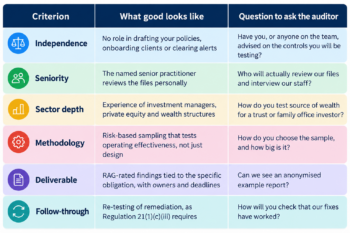
The fundamental compliance friction arises around the word independent. An internal compliance officer or an active MLRO who drafted the financial crime policies cannot objectively audit their execution. When supervisory teams from the FCA review anti-money laundering frameworks, they examine whether the audit function provides genuine second- or third-line challenge. The compliance friction sits in the word independent. Regulation 21(1)(c) of the MLRs 2017 does not require the auditor to be external, but it does require an audit function that is independent of what it examines. An MLRO or compliance officer who drafted the financial crime policies, clears monitoring alerts or signs off due diligence cannot objectively audit that work. In the three lines model, the independent audit is third-line assurance; second-line monitoring by compliance, however thorough, does not substitute for it. Where a firm has no internal audit team that is free of operational involvement and trained in financial crime, an external reviewer is usually the cleanest way to evidence independence to the FCA.
Mid-sized firms rarely possess the internal headcount to maintain a fully segregated internal audit department that has specialist financial crime training. The rules accommodate this reality. Under the FCA Senior Management Arrangements, Systems and Controls sourcebook (SYSC 8), regulated entities are permitted to outsource operational functions, including audit testing. However, the governing body remains fully accountable under regulatory rules. As outlined in Regulatory Counsel’s insights on outsourced compliance audits, outsourcing compliance reviews does not transfer regulatory liability away from the regulated firm; senior managers must demonstrate rigorous vendor selection and substantive ongoing oversight.
Before engaging an external auditor, your firm should verify that the appointment addresses these specific regulatory expectations:
- Complete independence from policy drafting, day-to-day onboarding, and alert clearing
- Documented testing methodologies that evaluate operating effectiveness, not merely theoretical manual designs
- Direct reporting lines to the board or audit committee, bypassing operational heads
- Full alignment with Joint Money Laundering Steering Group (JMLSG) guidance for the investment sector
- Retention of all working papers and sampling records to evidence compliance during supervisory reviews

Evaluating sector expertise against generalist approaches
London investment firms operate in a distinct risk environment compared to retail deposit-takers or payment service providers. Your financial crime risks stem from complex beneficial ownership structures, trusts in non-equivalent jurisdictions, nominee arrangements, and transactions involving private markets. A compliance partner who primarily audits consumer credit providers or high-street mortgage brokers will not have the context required to test an alternative investment fund’s investor intake. When selecting a specialist, understanding the delivery model is as significant as verifying regulatory credentials. For a broader framework on assessing regulatory advisory models, see our analysis on evaluating FCA compliance consultants: what to look for in a regulatory partner.
The danger of the junior checklist
In the firms we have reviewed, a recurring concern is the delivery model used by larger consultancies: a partner sells the engagement, but the file reviews and staff interviews are handed to junior analysts working from generic spreadsheets. These analysts often fail to distinguish between standard retail documentation gaps and the nuanced risk mitigations required for an institutional wealth management vehicle.
This mechanical approach creates severe operational friction. Junior reviewers often issue red-rated findings for perfectly legitimate, documented commercial structures because the file does not match an inflexible checklist. Conversely, they can miss critical exposure points, such as subtle source-of-wealth inconsistencies in an overseas family office, because the tick-box for proof of address was marked complete. The resulting report generates unnecessary internal panic while failing to shield the firm from real regulatory intervention.
Supervisory perspective and commercial reality
At Compliance Consultant, our delivery model operates differently. The firm was founded by Lee Werrell, who brings more than 25 years of UK financial services regulation experience to the oversight of every client engagement (see Compliance Doctor profile). Rather than relying on junior trainees, our team of seven qualified senior associate consultants delivers reviews based on how regulatory supervisors actually evaluate risk.
Senior practitioners understand the commercial reality of operating a boutique or mid-sized investment firm in Mayfair or the City. They test controls against the regulatory standard while recognising how trading desks, prime brokerage arrangements, and investment committees work in daily practice. This level of technical depth separates genuine assurance from hollow administrative box-checking.

Defining the scope of the external audit
An independent AML audit must examine what actually takes place on the operational floor, not merely what is written inside your compliance manual. When scoping an engagement, the Head of Compliance and the MLRO must establish clear boundaries that encompass every stage of the financial crime lifecycle. For an overview of our firm’s technical review parameters, examine our dedicated AML reviews and MLRO support services.
Business-wide risk assessment review
The foundation of your anti-money laundering framework is the Business-Wide Risk Assessment (BWRA). Under Regulation 18 of the MLRs 2017, firms must identify and assess the risks of money laundering and terrorist financing to which their business is subject. An external audit must examine whether this assessment remains an active, dynamic document or a static text created solely for authorisation.
The auditor must test whether your BWRA accounts for the full spectrum of risk factors:
- Client risk, specifically evaluating high-net-worth individuals, PEP exposure, and corporate structures with opaque ownership
- Geographic risk, testing exposures to jurisdictions identified on high-risk third country lists or subject to international sanctions
- Product and service risk, including complex derivatives, illiquid secondary assets, and co-investment vehicles
- Transaction and delivery channel risk, reviewing non-face-to-face onboarding, intermediary introductions, and reliance arrangements under Regulation 39
An effective audit identifies misalignments between the stated risk appetite in your BWRA and the actual accounts accepted onto the firm’s books.
Customer due diligence and monitoring
The core of the external audit requires rigorous file sampling across your active investor base. The auditor must pull representative samples of standard Customer Due Diligence (CDD), Simplified Due Diligence (SDD), and Enhanced Due Diligence (EDD) files.
For institutional investment firms, the review must evaluate the corroboration of Source of Wealth (SoW) and Source of Funds (SoF). Auditors should not just confirm that a bank statement is on file. They must examine whether the narrative supporting an investor’s accumulated wealth is plausible, documented, and properly verified against independent third-party sources.
Beyond onboarding files, the audit must evaluate ongoing monitoring and internal escalation procedures. The auditor must review your threshold alerts, manual trading reviews, and the log of internal suspicious activity reports made to the Nominated Officer. How does the MLRO handle internal escalations? Are determinations to submit or withhold a Suspicious Activity Report (SAR) to the National Crime Agency (NCA) fully reasoned and documented? The audit should verify these decision-making trails with total impartiality.

What this means in practice
When an external AML audit is concluded, the Head of Compliance should receive a clear operational asset, not an academic thesis that sits unread on a server. The deliverable must translate regulatory findings into a clear, Red-Amber-Green (RAG) action plan designed directly for the board of directors and the audit committee.
Each finding in the final report should state the exact regulatory obligation, the observed operational deficiency, the systemic risk to the firm, and a proportionate remediation step. If an auditor notes that your EDD files lack sufficient source-of-wealth verification on non-executive directors of corporate clients, the solution must specify the exact evidentiary standard required to close the gap.
+-------------------------------------------------------------------------------+
|                       SAMPLE RAG AUDIT REMEDIATION ITEM                       |
+-------------------------------------------------------------------------------+
| FINDING: EDD files for overseas corporate investors lack independent source   |
|          of wealth corroboration (MLRs 2017 Reg 33).                          |
| RISK RATING: HIGH (RED)                                                       |
| SUPERVISORY IMPACT: Risk of formal supervisory intervention or skilled person |
|                     review under FSMA Section 166.                            |
| REMEDIATION REQUIREMENT: Update the institutional CDD procedure to mandate   |
|                          certified audited accounts or verified bank letters;  |
|                          re-mediate the identified 12 high-risk accounts.     |
| TARGET COMPLETION: 30 business days.                                          |
+-------------------------------------------------------------------------------+
This structural clarity matters for individual accountability. Under SMCR, the MLRO holds the SMF17 function in Core and Enhanced firms, and a Senior Manager is allocated the prescribed responsibility for the firm’s policies and procedures for countering the risk that it might be used to further financial crime. Under the Duty of Responsibility, those individuals must be able to show they took reasonable steps. Presenting an independent audit report to the governing body, and tracking each finding to closure, is some of the most direct evidence of reasonable steps a Senior Manager can hold. Presenting an independent, professionally conducted AML audit report to your governing body proves that senior management is actively identifying vulnerabilities and allocating resources to correct them.
A robust audit also helps firms avoid severe regulatory sanctions. Where the FCA has concerns about a firm’s systems and controls, it can require a skilled person report under section 166 of the Financial Services and Markets Act 2000, at the firm’s expense. An independent audit that has already identified the weaknesses, with a remediation plan the board is tracking, puts the firm in a far stronger position if supervisors start asking questions. Where something significant does emerge, it should also inform whether a Principle 11 notification is needed; see our analysis on drafting an FCA Principle 11 notification: SUP 15 submissions that prevent a Section 166. Where significant issues are identified early, firms can manage communications cleanly with the regulator; for guidance on structured regulatory reporting, review our analysis on drafting an FCA Principle 11 notification: SUP 15 submissions that prevent a Section 166.
When executing regulatory change, we apply a structured three-stage approach: engage, execute, and embed. We define engage as establishing regulatory requirements before infrastructure is built; execute as driving process and organisational change in parallel with technology development; and embed as integrating compliance into real-world operations through testing and scaling. Applying this discipline ensures that an AML audit is not treated as a disruptive annual interruption, but as an operational baseline that protects your firm’s market standing.
Frequently asked questions
Is an independent AML audit mandatory for FCA-regulated investment firms?
Regulation 21(1)(c) of the MLRs 2017 requires an independent audit function where appropriate with regard to the size and nature of the business. Firms managing client assets, onboarding high-net-worth or corporate investors, or dealing with offshore structures will find it hard to justify not having one, and should record their reasoning in the business-wide risk assessment either way.
Does the AML auditor have to be external?
No. The requirement is independence, not external appointment. An internal auditor with no involvement in designing or operating the AML controls can meet it. In practice, most mid-sized investment firms lack such a person, so an external reviewer is the simplest way to evidence independence.
How often should an investment firm have an independent AML audit?
The MLRs 2017 do not set a frequency. Base it on your business-wide risk assessment, and bring the audit forward after a material change, such as a new product, rapid growth, a change of MLRO or a supervisory concern.
What does an independent AML audit cover?
The business-wide risk assessment (regulation 18); policies, controls and procedures (regulation 19); customer due diligence and enhanced due diligence files (regulations 27 to 33); reliance arrangements (regulation 39); ongoing monitoring; internal suspicious activity reporting and SAR decisions; staff training (regulation 24); and record-keeping (regulation 40).
Who should receive the audit report?
The governing body or audit committee, directly, not via the operational heads whose controls were tested. Each finding should state the obligation, the deficiency observed, the risk and a proportionate remediation step with an owner and a deadline.
To evaluate your firm’s financial crime controls, discuss your regulatory permissions, or scope an independent AML audit with an experienced team, book a free discovery call with Compliance Consultant via our discovery booking portal or contact our team directly at 0800 689 0190.

